20 Oct 2026
Leasehold vs Freehold Condo in Singapore: Which Should I Buy?
Compare leasehold and freehold condos in Singapore, including prices, CPF rules, loans, rental returns and when paying more for freehold makes sense.
By John Lai | CEA R064872C
Research and policy checks: 20 October 2026
I would choose a leasehold condo when the location, usable space and lower price give you a better home within your budget, with enough lease left for your plans. Freehold deserves a closer look when you want to hold for decades and can afford the extra cost comfortably. Neither tenure guarantees better returns. The price you pay and the home’s future appeal still matter.
This guide covers private condos. The buying examples below compare two completed homes.
What is the difference between leasehold and freehold?
Tenure tells you how long the property interest lasts. With a typical strata-titled condo, you own your unit and share the common property with other owners. You do not own the whole development or decide alone how the land will be used. Check the actual title before buying. [4] [24]
What does a 99-year lease mean?
A 99-year lease runs from the start date stated in the title. Buying a resale unit does not restart the lease. If about 25 years have passed, about 74 years remain.
When the lease ends, the leasehold ownership ends. The land and buildings revert to the landowner, usually the State for a State lease. Some leases sit on privately owned land. SLA’s general policy is to let State leases expire, with renewal considered case by case. A renewal is not automatic and may require a land premium. [1]
Is a 999-year lease the same as freehold?
A 999-year property is still leasehold, with an expiry date. However, a title with several hundred years remaining gives a household a very different ownership horizon from a short remaining 99-year lease. Check the start date and balance lease rather than treating the number 999 as a fresh lease. [2] [24]
Does freehold mean I can keep the home forever?
Freehold has no fixed lease expiry. That gives you more flexibility to hold for a long time. The building still needs repairs, and freehold property can be affected by a lawful collective sale or government acquisition. Freehold describes the title, not a promise that the same building will stay unchanged forever. [2] [3] [21]
Does a newer condo always have a longer lease left?
No. Building age and lease age are different.
For example, a condo completed 10 years ago could stand on a lease that started 15 years ago. The building is 10 years old, but a 99-year lease would have about 84 years left.
A newly completed freehold home and an older freehold home both have no fixed lease expiry. Their condition, facilities and repair needs can still differ greatly.
I would check the lease start date, completion date and condition separately. A newer building does not reset an existing land lease.
Will freehold or leasehold give me better price growth?
Capital appreciation means the increase in your home’s value. Freehold removes the problem of a lease running down. Leasehold can still perform well when the buying price is competitive and demand strengthens.
The research gives different answers for different groups of homes. That is why I would not assign one fixed yearly growth rate to all freehold condos and another to all leasehold condos.
What do the numbers tell us?
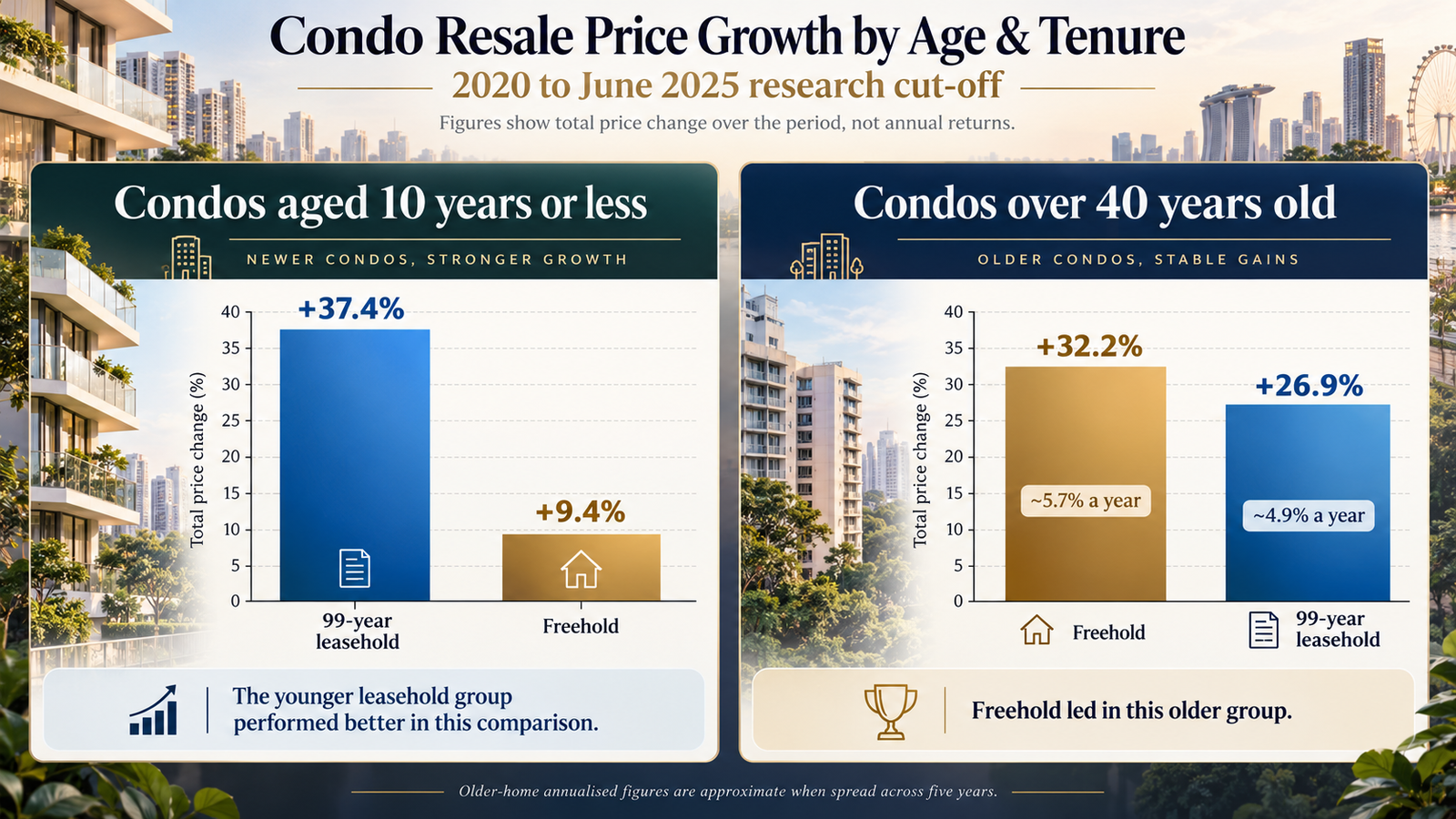
For condos aged 10 years or less, average resale prices rose 37.4% for 99-year leasehold and 9.4% for freehold between 2020 and the June 2025 research cut-off. These were total changes over that period, not annual returns. The younger leasehold group performed better in that comparison. [14]
Older homes showed a different pattern. For condos over 40 years old, average resale prices rose 32.2% for freehold and 26.9% for 99-year leasehold from 2020 to 2025. Those changes work out to roughly 5.7% and 4.9% a year when spread evenly across five years. Freehold led in this older group. [13]
These figures track average prices across groups. They do not show the profit from buying and selling the same unit. Differences in location and the homes sold can affect the result.
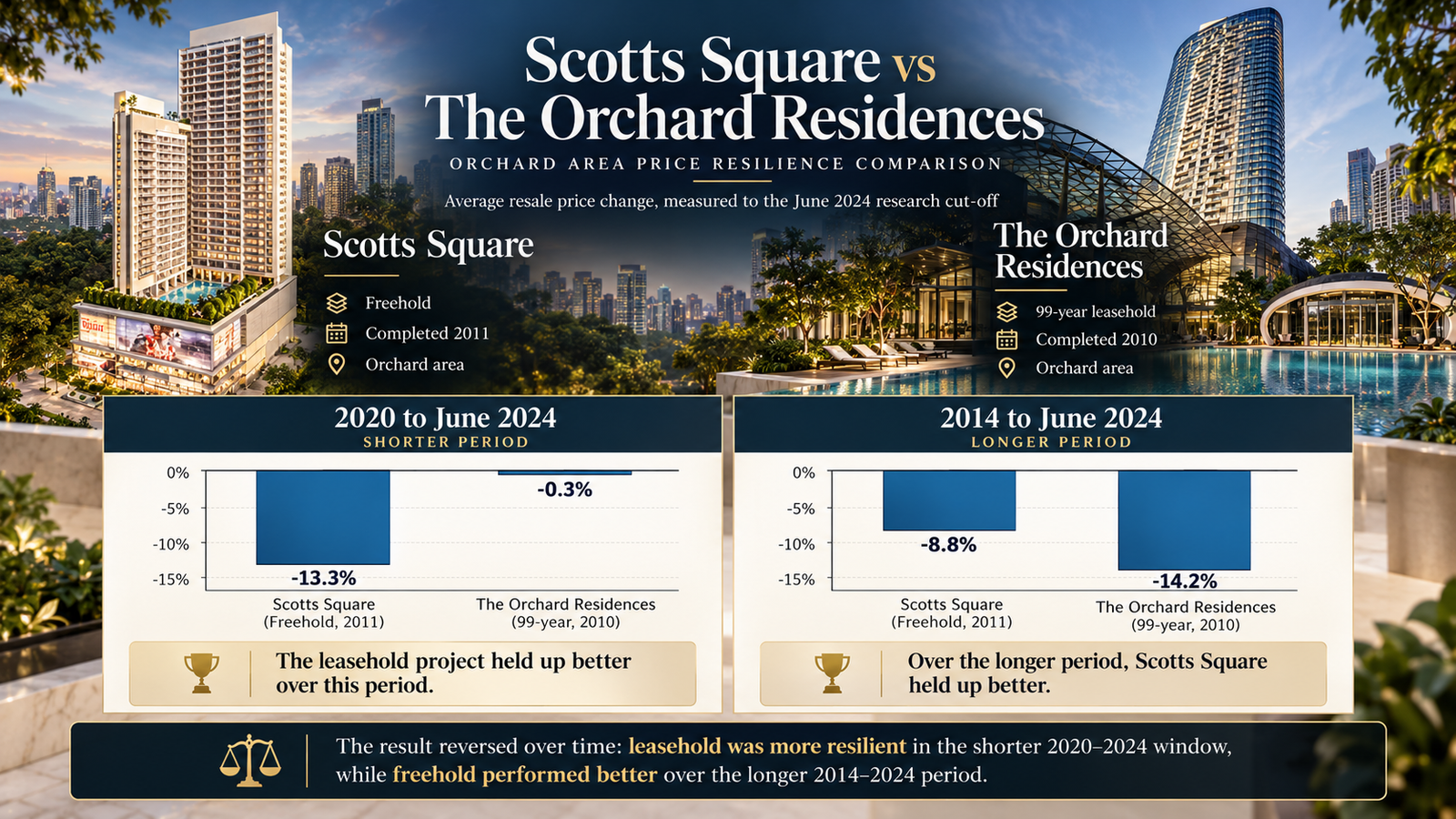
Let’s do a comparison to show why timing matters. Freehold Scotts Square and leasehold The Orchard Residences are in the Orchard area and were completed in 2011 and 2010. From 2020 to June 2024, their average resale prices fell 13.3% and 0.3% respectively. The leasehold project held up better over that period. [15]
Over the longer period from 2014 to June 2024, the result reversed. Scotts Square fell 8.8%, compared with 14.2% for The Orchard Residences. These are historical project averages, with different unit mixes and few recent transactions. They illustrate why the buying period and property features matter, rather than proving one tenure is superior. [15]
Why can a leasehold condo perform better?
A lower buying price can leave more room for growth. Convenient transport, practical layouts and nearby jobs or shops can also give buyers reasons to choose the home.
For example, two homes may serve the same family needs, but one costs much less. If future buyers value the location and layout, the lower-priced home may deliver a stronger percentage gain. That reasoning can favour leasehold when the freehold premium is large.
Freehold becomes more relevant when you expect to hold for several decades, especially against an alternative with a much shorter lease. Even then, paying too much can reduce your return. A higher eventual selling price also needs to cover taxes, interest, upkeep and selling costs.
How much more would I pay for freehold?
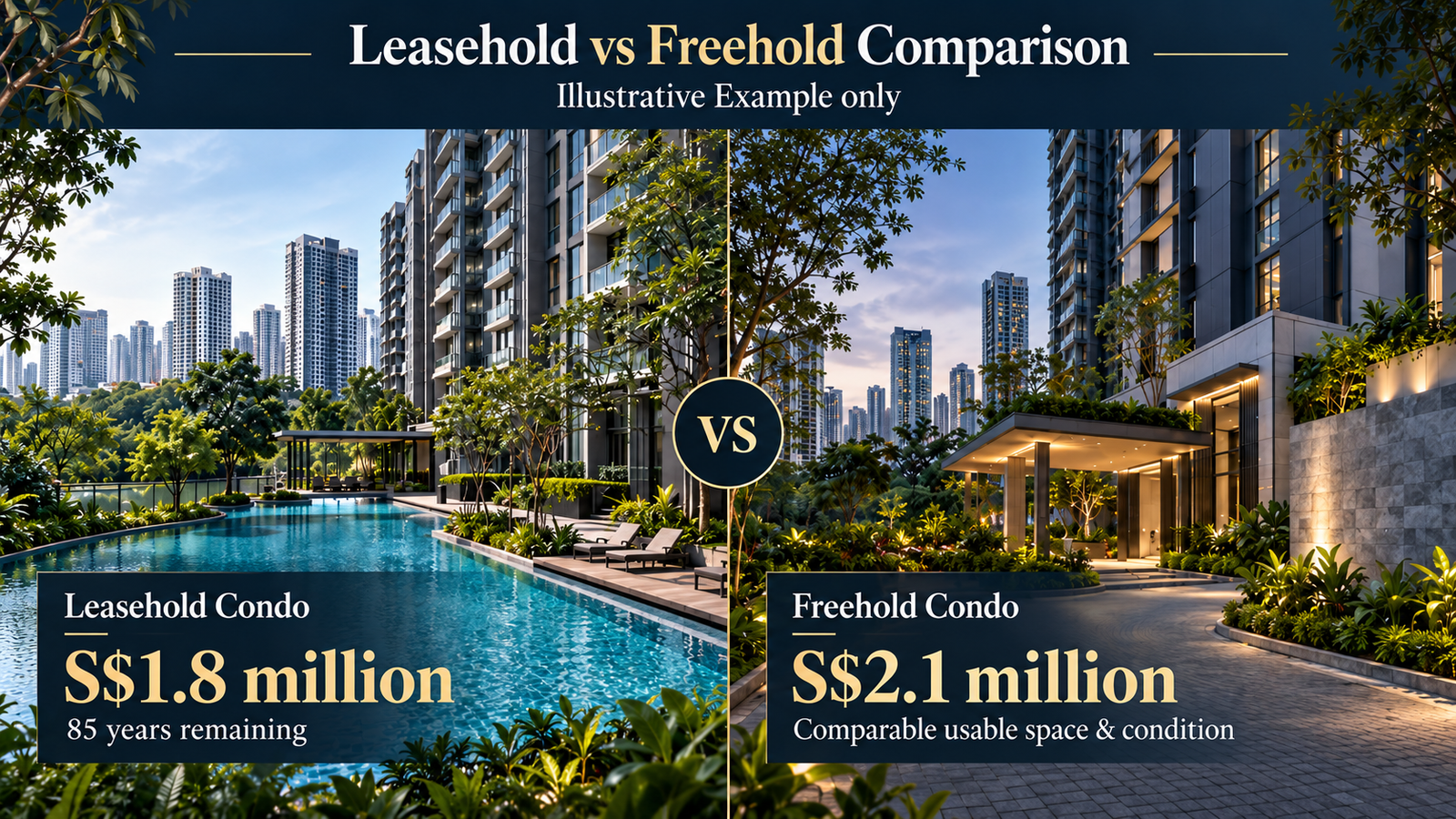
Let’s compare a S$1.8 million leasehold condo with a S$2.1 million freehold condo. These are hypothetical prices, not listings or a claim that freehold always costs 16.7% more.
Assume the homes have comparable usable space and condition. Assume one Singapore Citizen aged 35 buys a first residential property, has no outstanding housing loan, and qualifies for a 75% bank loan over 30 years. The bank valuation equals the purchase price. The leasehold home has 85 years remaining.
These assumptions matter. The maximum loan depends on your income, debts, age, property and lender assessment. The 75% limit can fall where the loan exceeds 30 years or extends beyond age 65. Total monthly debt payments are generally subject to the 55% Total Debt Servicing Ratio limit. [9] [10]
What would I need upfront?
For the S$1.8 million leasehold home, the loan is S$1.35 million. You pay S$450,000 of the price yourself, including at least S$90,000 in cash. Buyer’s Stamp Duty is S$59,600. The down payment plus this tax comes to S$509,600. [9] [11]
For the S$2.1 million freehold home, the loan is S$1.575 million. You pay S$525,000 of the price yourself, including at least S$105,000 in cash. Buyer’s Stamp Duty is S$74,600. The down payment plus this tax comes to S$599,600. [9] [11]
The freehold option needs S$90,000 more upfront and a loan that is S$225,000 larger. The minimum cash amounts form part of the down payments. They are not extra charges.
The remaining down payment can come from cash and CPF Ordinary Account savings you are allowed to use. Stamp duty follows the higher price or market value. No Additional Buyer’s Stamp Duty applies under this first-property Singapore Citizen assumption. [5] [11] [12]
These totals are not your complete moving budget. Add legal and valuation fees, renovation, furniture, moving expenses and a savings buffer. CPF cannot cover every item.
How much would I pay each month?
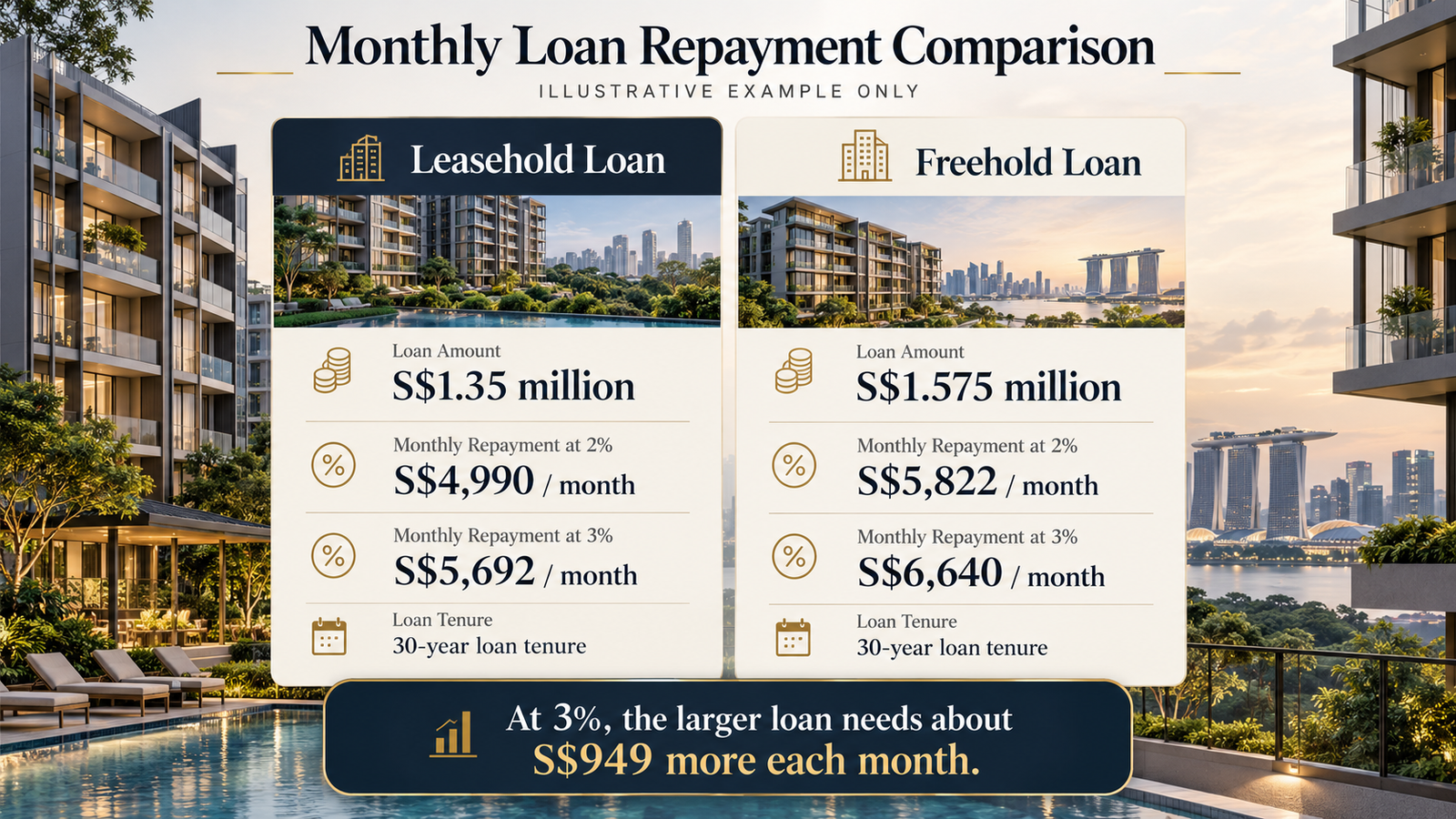
For the S$1.35 million leasehold loan over 30 years, the monthly payment is about S$4,990 at 2% interest or S$5,692 at 3%.
For the S$1.575 million freehold loan over 30 years, the monthly payment is about S$5,822 at 2% or S$6,640 at 3%.
At 3%, the larger loan needs about S$949 more each month. Differences are calculated before rounding. These examples assume a constant rate and a fully drawn loan. They are not bank offers or loan-approval tests.
You also pay maintenance, property tax, insurance and repairs. I would check whether the higher monthly commitment still leaves room for family expenses and savings. If freehold means compromising the space you need or using almost all your savings, the premium may be too high for your household.
How does the remaining lease affect CPF and bank loans?
How much CPF can I use?
For a purchase under the current CPF rules, the remaining lease must be more than 20 years. CPF also checks whether the lease covers the youngest owner using CPF until age 95. If the lease falls short, the permitted CPF amount is reduced. [5] [6]
A buyer aged 35 needs 60 years of remaining lease to meet the age-95 test. With 55 years left, that buyer reaches only age 90 before expiry, so the CPF limit is reduced. A 45-year-old buyer of the same home reaches age 100 and meets the age-95 test.
Meeting this test does not mean unlimited CPF use. Other withdrawal limits still apply. Use CPF’s housing calculator with the actual buyers’ dates of birth, valuation and lease details. [7]
Can a shorter lease mean higher monthly payments?
Yes, if the bank offers a shorter repayment period. For example, UOB’s published private-home-loan criteria require at least 30 years of lease remaining at the end of a leasehold loan. With 50 years left, that condition would limit the term to 20 years, before other checks. This is one lender’s criterion, not a universal promise from every bank. [8]
For an assumed S$1 million loan at 3%, repayment over 30 years is about S$4,216 a month. Over 20 years, the payment is about S$5,546, around S$1,330 more. The shorter loan repays the debt faster, but requires more each month.
This also affects your future buyer. A home bought with 65 years left has about 55 years left after a 10-year hold. A new buyer aged 35 would then face the reduced CPF limit described above. Some buyers may need more cash or a smaller loan, which can affect demand and offers.
Is a freehold condo cheaper to maintain?
Tenure alone does not determine maintenance fees. The estate budget, facilities, number of units sharing costs and your unit’s share value matter. Both leasehold and freehold owners contribute to common-property upkeep. [4]
Before buying, review recent management accounts, meeting minutes and planned works. Check the sinking fund, which holds money for major repairs and replacements. Ask whether owners may need to make additional contributions for work such as lift replacement or waterproofing. [25]
A well-maintained older condo may serve your family well. A freehold title does not remove the need to pay for ageing lifts, pipes or roofs.
Which gives me better rental income?
Start with what a tenant would pay for the actual home. Do not assume a freehold title earns higher rent. Compare signed rentals for similar size, condition, location and facilities.
Suppose either home rents for S$4,500 a month. A full year brings S$54,000 before expenses. Against the S$1.8 million leasehold price, that is a 3% gross rental yield. Against S$2.1 million, the freehold yield is about 2.57%.
To match a 3% gross yield, the freehold home would need S$5,250 a month, or S$750 more. These rents are assumptions, not rental forecasts.
How much rent would remain after costs?
For either home, assume one empty month, leaving S$49,500 in rent. Budget S$4,800 a year for maintenance, S$1,200 for repairs and insurance, and S$1,800 for tenant-finding costs spread across the year.
Assume an IRAS Annual Value of S$36,000. Under the non-owner-occupier rates checked on 20 October 2026, annual property tax would be S$4,800. Annual Value is IRAS’s rental-value assessment and can differ from the rent you collect. [16] [17]
After these assumed costs, S$36,900 remains before the mortgage and personal income tax. Using the 3% loans above, you would add about S$2,617 a month for the leasehold home or S$3,565 for the freehold home, averaged over the year.
Part of each mortgage payment repays your loan principal, so this top-up is a cash-flow measure, not an investment loss. The example holds rent and operating costs equal to show the effect of the purchase price. Actual homes need their own rental and cost checks.
Is freehold better if I want to leave a home to my children?
Freehold can be a sensible choice for that goal because there is no fixed lease expiry. A 999-year title with a long balance lease may also meet a family’s long-term plans.
A leasehold condo can also be inherited, but your children receive the remaining lease. They do not receive a new 99-year term.
Think about the home your children would receive, including the remaining loan, future repair bills and whether the location and layout suit them. An inherited residential interest can also count towards their property ownership for future ABSD purposes. Review the ownership and estate arrangements before treating a purchase as a legacy plan. [12]
Can I count on an en bloc sale?
No. An en bloc sale means selling the development together, commonly to a developer. The process needs the required owner consent, a buyer and the applicable legal approvals. Age or tenure alone cannot secure a sale. [21]
Freehold can remove the need to renew a fixed land lease. A leasehold redevelopment may require approval and payment to extend the lease. For either tenure, the buyer still needs the land price, permitted development and construction costs to make commercial sense. [1]
I would buy a home that works for your own stay or rental plan without an en bloc sale. Treat a future collective sale as a possibility, with the applicable rules checked for that development and sale exercise.
Which would I choose for your situation?

For HDB upgraders and first-time buyers, I would favour a well-located leasehold condo when the lower price buys the space you need and leaves a healthier savings buffer. The lease must still support your planned ownership and the needs of likely future buyers. I would not trade a workable family layout for freehold status alone.
For families buying a long-term home, freehold or a long 999-year lease deserves consideration when the price difference is manageable. The strongest reason is the flexibility to hold for decades. Check that you are also buying a suitable location, a useful layout and a building with a sound maintenance plan.
For investors, I would choose the home with the stronger numbers at the actual asking price. A cheaper leasehold purchase can produce a better rental yield when comparable homes earn similar rent. Freehold may justify a premium where long-term ownership matters, but the premium still needs to fit your costs and likely resale demand.
Before deciding, shortlist one suitable home of each tenure in the same area. Compare recent transactions, usable space, condition, remaining lease, rent and full monthly costs. URA’s transaction service is a useful starting point. [23]
My decision rule is simple: pay extra for freehold when the longer ownership horizon serves a clear purpose and the additional cost is comfortable. Choose leasehold when the better location, space or price gives you more value, with enough lease left for your plans.
Choosing between two condos?
WhatsApp me at 84440899 with your budget, preferred area and how long you plan to hold. We can compare the homes and work out whether paying extra for freehold makes sense for you.
Common questions
1. Is a 99-year condo a bad investment?
No. A leasehold condo can perform well when bought at a sensible price and supported by buyer or tenant demand. Check the remaining lease at purchase and when you expect to sell, alongside the full costs.
2. How much extra should I pay for freehold?
There is no single premium that suits every home. Compare similar homes nearby and work out the extra down payment, tax and monthly cost. Pay more only when the benefit fits your plans and budget.
3. Does a condo lose value every year as the lease gets shorter?
The lease gets shorter each year, but the market price does not have to fall every year. Stronger demand can raise prices during your ownership. A shorter remaining lease can still create financing and resale challenges later.
4. Is 999-year leasehold good enough for a long-term family home?
A title with hundreds of years remaining can support a long ownership plan. Check the actual lease and property condition. A long tenure alone does not make the asking price reasonable.
5. Can I use CPF to buy an older leasehold condo?
Possibly. Under the current rules, more than 20 years of lease must remain. CPF usage may be reduced if the lease does not cover the youngest owner using CPF to age 95. Check your permitted amount before committing. [5] [6] [7]
Disclaimer
This report is for informational purposes only and is based on available data and assumptions at the time of preparation. Actual outcomes may differ due to market conditions, execution, and other uncertainties. No guarantee of accuracy, completeness, or future performance is made. Readers should independently verify key information before making decisions. John Lai shall not be held responsible for any subsequent changes or inaccuracies.
Source
Sources checked on 20 October 2026.
[1] SLA, Lease Policy
[2] 99.co, Freehold vs 999/99-year leasehold condos, 24 June 2022
[3] SLA, Acquisition of land
[4] BCA, What to know as a condo owner
[5] CPF Board, CPF savings for your home purchase
[6] CPF Board, Minimum remaining lease for CPF use
[7] CPF Board, Housing usage calculator
[8] UOB, Private Home Loan, maximum repayment period
[9] MAS, Loan tenure and loan-to-value limits
[10] MAS, Total Debt Servicing Ratio thresholds
[11] IRAS, Buyer’s Stamp Duty
[12] IRAS, Additional Buyer’s Stamp Duty
[13] EdgeProp, Freehold condos’ enduring appeal, 5 March 2026
[14] EdgeProp, Price growth of condos launched in 2014, 4 June 2025
[15] EdgeProp, Scotts Square and The Orchard Residences comparison, 25 June 2024
[16] IRAS, Property tax rates
[17] IRAS, About Annual Value
[18] HDB, Acquiring Private Property
[19] CPF Board, Refund when selling or transferring property
[20] IRAS, ABSD remission for a married couple
[21] Strata Titles Boards, Collective sale process
[22] IRAS, Seller’s Stamp Duty for residential property
[23] URA, Private residential property transactions
[24] SLA, Land Titles Search
[25] BCA, Ageing condos and sinking funds, 26 August 2025