12 Oct 2026
New EC Rules in Singapore: Can I Still Buy?
Can you still buy an EC? Understand Singapore’s new rules, income limits, upfront costs and what HDB upgraders need to plan before buying.
By John Lai
CEA R064872C | Updated 10 October 2026
YES! An Executive Condominium, or EC, may still be an option for you. HDB upgraders can still apply if they meet the rules. The answer depends on your family, income, property history and the project you choose. Two points matter straight away: the S$18,000 income ceiling doesn’t cover every new EC, and being eligible to buy doesn’t guarantee a 75% bank loan. [1][2][3]
What changed, and which EC projects are affected?
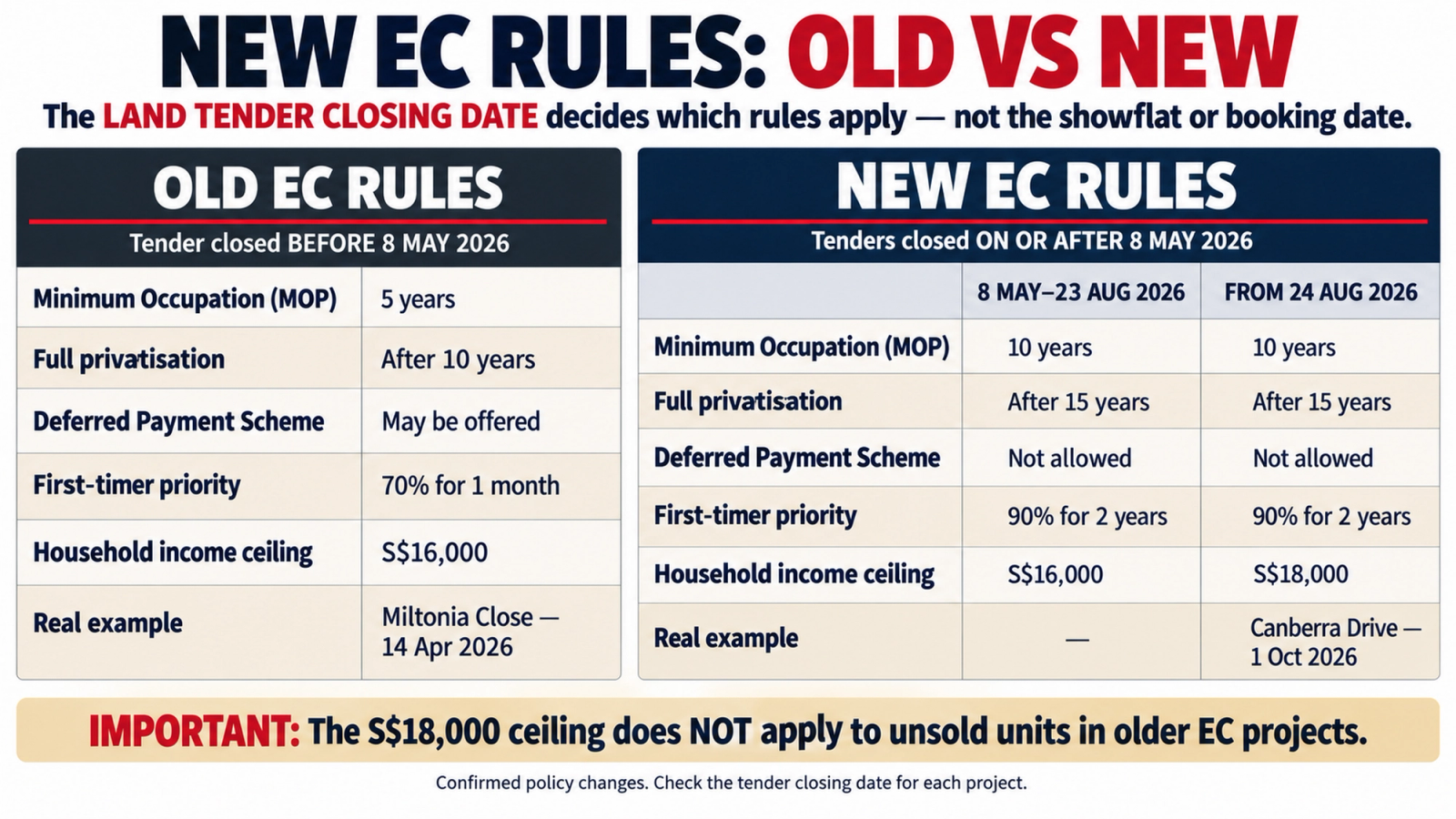
A private developer builds and sells a new EC, but HDB sets rules on who can buy and how the home can be used. For the 2026 changes, start with the land-tender closing date. That’s the deadline for developers to bid for the land. The date you visit the showflat doesn’t decide which rules apply.
If the land tender closed before 8 May 2026, the earlier rules apply. The Minimum Occupation Period, or MOP, is five years. That’s the period you must live in the home before a normal resale. Full privatisation comes after 10 years. The developer may offer deferred payment, and 70% of units are reserved for first-timers during the first month of launch. The income ceiling is S$16,000. [1][2][4][5]
The changes announced on 8 May 2026 apply to land tenders closing from that date. For tenders closing from 8 May to 23 August 2026, the MOP becomes 10 years and full privatisation comes after 15 years. Deferred payment is removed. Developers must reserve 90% of units for first-timer families for two years. The income ceiling stays at S$16,000. [1][2]
For land tenders closing on or after 24 August 2026, these rules also apply, but the income ceiling rises to S$18,000. HDB announced the increase on 22 August. Unsold units in earlier projects don’t automatically get the higher ceiling. [2]
These changes are confirmed, though buyers will encounter them as the affected projects launch. If your household earns S$17,000, a later project may be an option while an earlier one may not qualify.
For example, the Miltonia Close land tender closed on 14 April 2026. Canberra Drive closed on 1 October 2026. Both dates fall in 2026, but the projects follow different rules. These land dates tell you which rules apply, not whether homes are currently on sale. [6]
Can my family still apply for a new EC?
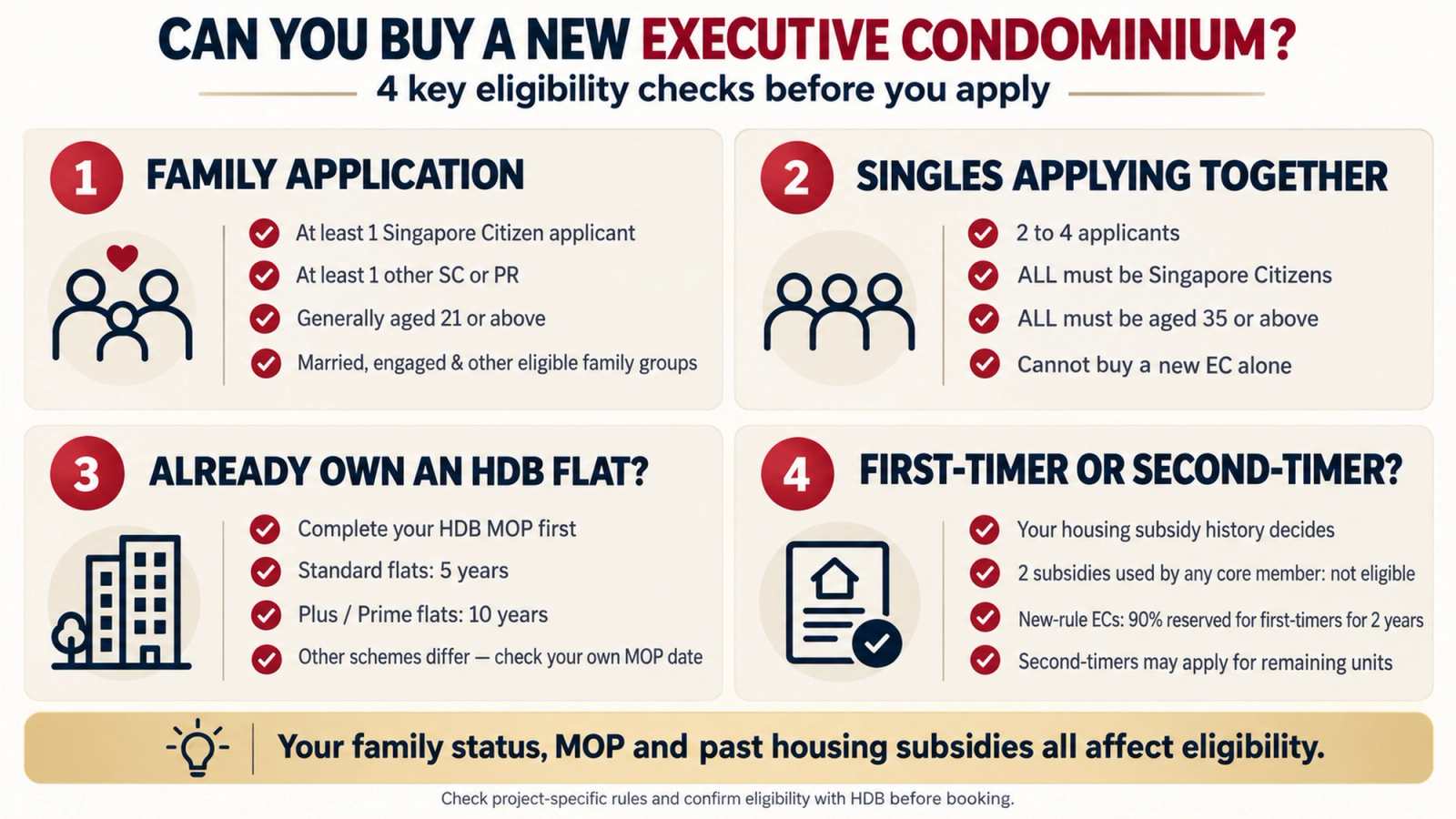
For a typical family application, you need a Singapore Citizen applicant and at least one other Singapore Citizen or Permanent Resident. Applicants generally need to be at least 21. Married and engaged couples can apply, along with other eligible family arrangements. Two to four singles can apply together if everyone is a Singapore Citizen aged at least 35. You can’t buy a new EC alone as a single person. [3]
Already own an HDB flat? You need to finish your flat’s MOP before applying for a new EC. Many flats have a five-year MOP, while Plus and Prime flats have 10 years. Other schemes can differ, so check the date shown for your own flat. [7]
Whether you count as a first-timer depends on the housing subsidies you’ve received. For example, someone who bought a resale flat without a grant may have a different status from a Build-To-Order, or BTO, flat owner. If anyone in the household used to qualify for the purchase has already received two housing subsidies, another new EC isn’t an option. [3][17]
Second-timers can still apply under the newer rules. But with 90% of units reserved for first-timer families for two years, second-timers have fewer units to choose from during that period. Any remaining units open to all eligible buyers after the two years. [1]
Which parts of my income count?
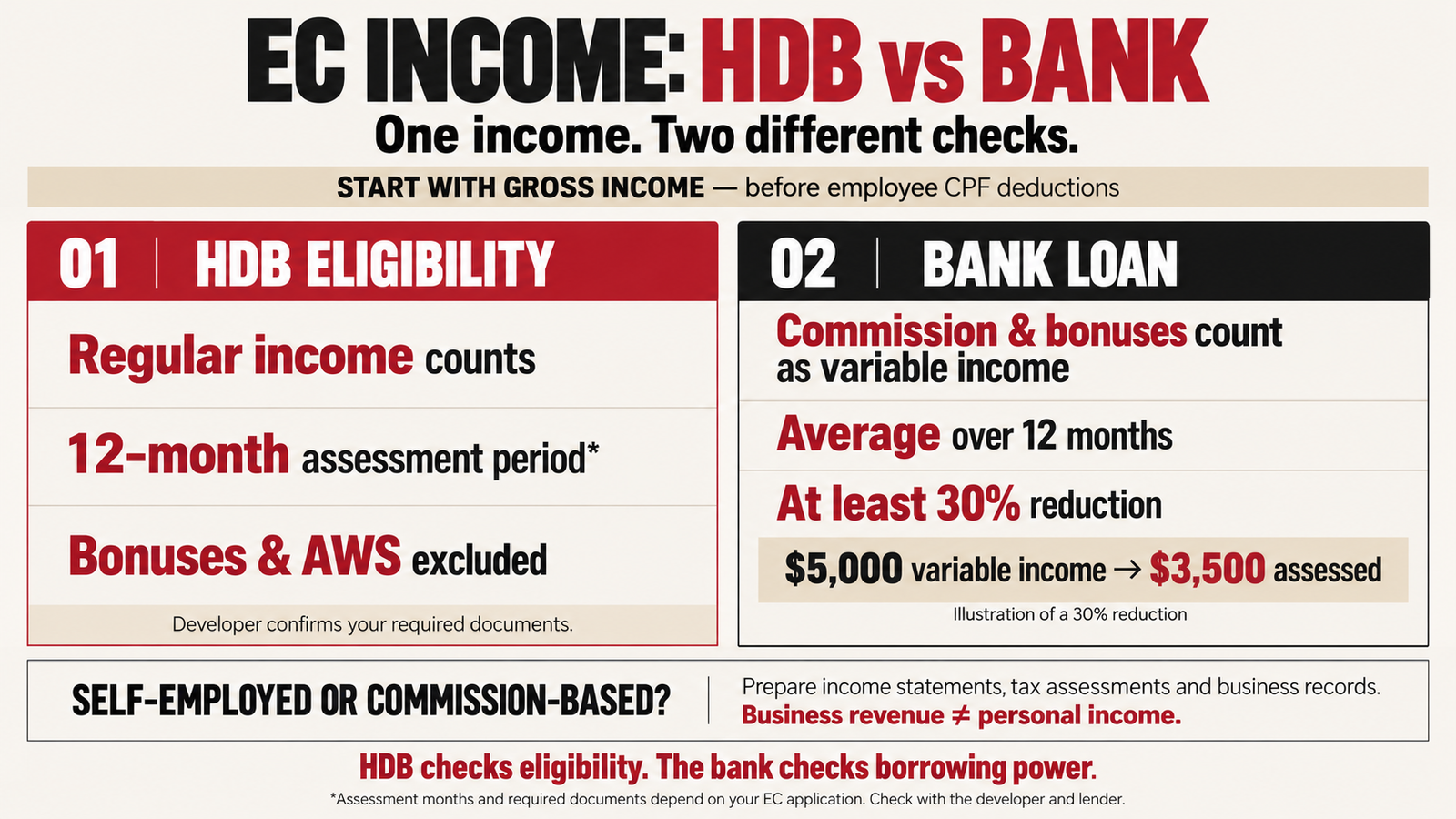
Start with your gross income before employee CPF deductions, rather than the amount reaching your bank account. HDB’s income-assessment changes use a 12-month period where income months are available, with the changes extending to new EC purchases where relevant. Your developer handles the application and confirms which months and documents HDB needs. [3][8][9]
Bonuses and Annual Wage Supplement are excluded under HDB’s income guidelines. Regular employment or business income counts. If you earn commission or run a business, prepare your income statements, tax assessments and business records. Your business’s sales are not the same as your personal income. [8]
The bank makes a separate calculation for your loan. For the Total Debt Servicing Ratio, variable income such as commission and bonuses is averaged over the previous 12 months, then reduced by at least 30% for assessment. So the income used to check your EC eligibility may differ from the income the bank accepts for borrowing. [10]
What if I own a condo or a home overseas?
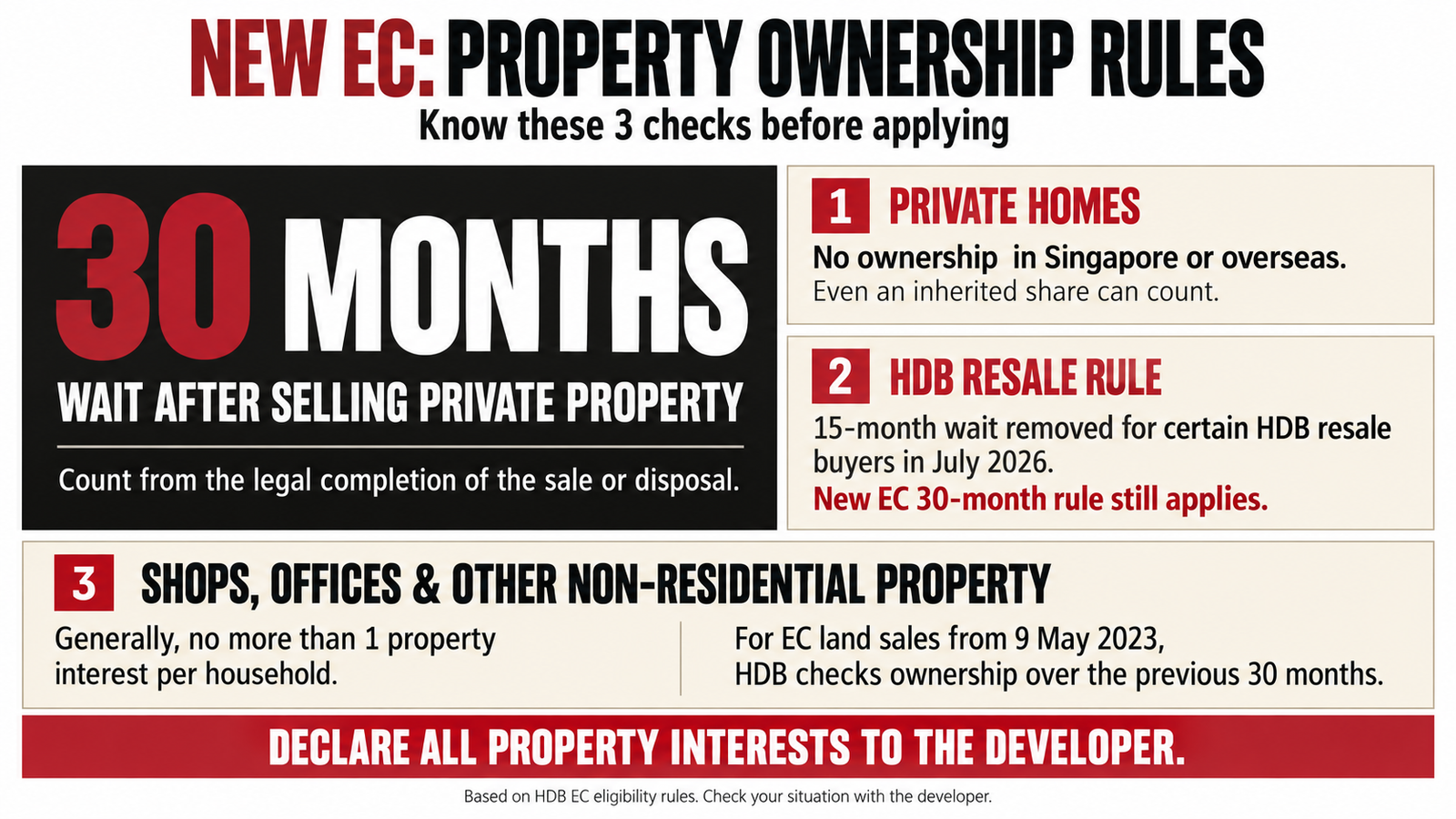
For a new EC, applicants and listed occupiers must not own private residential property in Singapore or overseas. You generally need to wait at least 30 months after legally completing the sale or disposal before applying. A share in a property, including one you inherited, can also count. [3]
You may have heard that the 15-month wait for certain HDB resale purchases was removed in July 2026. That was a different rule. The 30-month wait for a new EC still applies. [11]
Shops, offices and other non-residential properties have separate rules. For EC land sales launched from 9 May 2023, the household can generally have an interest in no more than one such property. HDB also looks at ownership during the previous 30 months. Let the developer know about all your property interests when checking eligibility. [3]
Would a resale EC suit me better?
A resale EC can offer another route. Once the project has passed its MOP, there’s no household income ceiling and singles aged at least 21 can buy. Before full privatisation, buyers must be Singapore Citizens or Permanent Residents. After full privatisation, foreigners and companies can also buy, subject to the relevant taxes and rules. [5]
For earlier projects, resale starts after five years and full privatisation comes after 10. For projects under the newer rules, the milestones are 10 and 15 years. Both periods count from the Temporary Occupation Permit, or TOP, which allows the building to be occupied. Buying a resale unit doesn’t restart these project timelines. [4][5]
Resale EC purchases don’t qualify for a Central Provident Fund, or CPF, housing grant, and no resale levy is payable for that purchase. The new-EC rule limiting assessed mortgage payments to 30% of income no longer applies after the MOP, although the other bank-loan checks still do. [5][12]
If you own an HDB flat, you still need to finish the flat’s MOP before buying a resale EC. Permanent Resident households must also sell their HDB flat within the required six months. [5]
How much will the bank lend me?
You’ll need a bank loan for a new EC, because HDB doesn’t provide the housing loan. Two checks matter. The Mortgage Servicing Ratio, or MSR, generally caps your assessed home-loan repayment at 30% of gross income. The Total Debt Servicing Ratio, or TDSR, caps all assessed debt repayments at 55%. Car loans and other debts can reduce how much you can borrow. [12][24]
Banks use at least 4%, or the relevant higher rate, to test affordability. That check applies even when the mortgage rate you’re offered is lower. [10][25]
For a qualifying borrower with no outstanding housing loan, the usual maximum loan is 75% of the property value. Borrowing for more than 30 years, or beyond age 65, lowers that limit to 55% for this loan category. EC loans can run up to 35 years, but a longer loan doesn’t automatically mean you can borrow more. Other housing loans can lower the limit too. [13]
Your approved loan must pass all these checks. So before setting aside a 25% down payment, find out your actual borrowing limit. You may need to put in more cash or CPF than you first expected.
What would a S$1.6 million EC cost a first-time family?
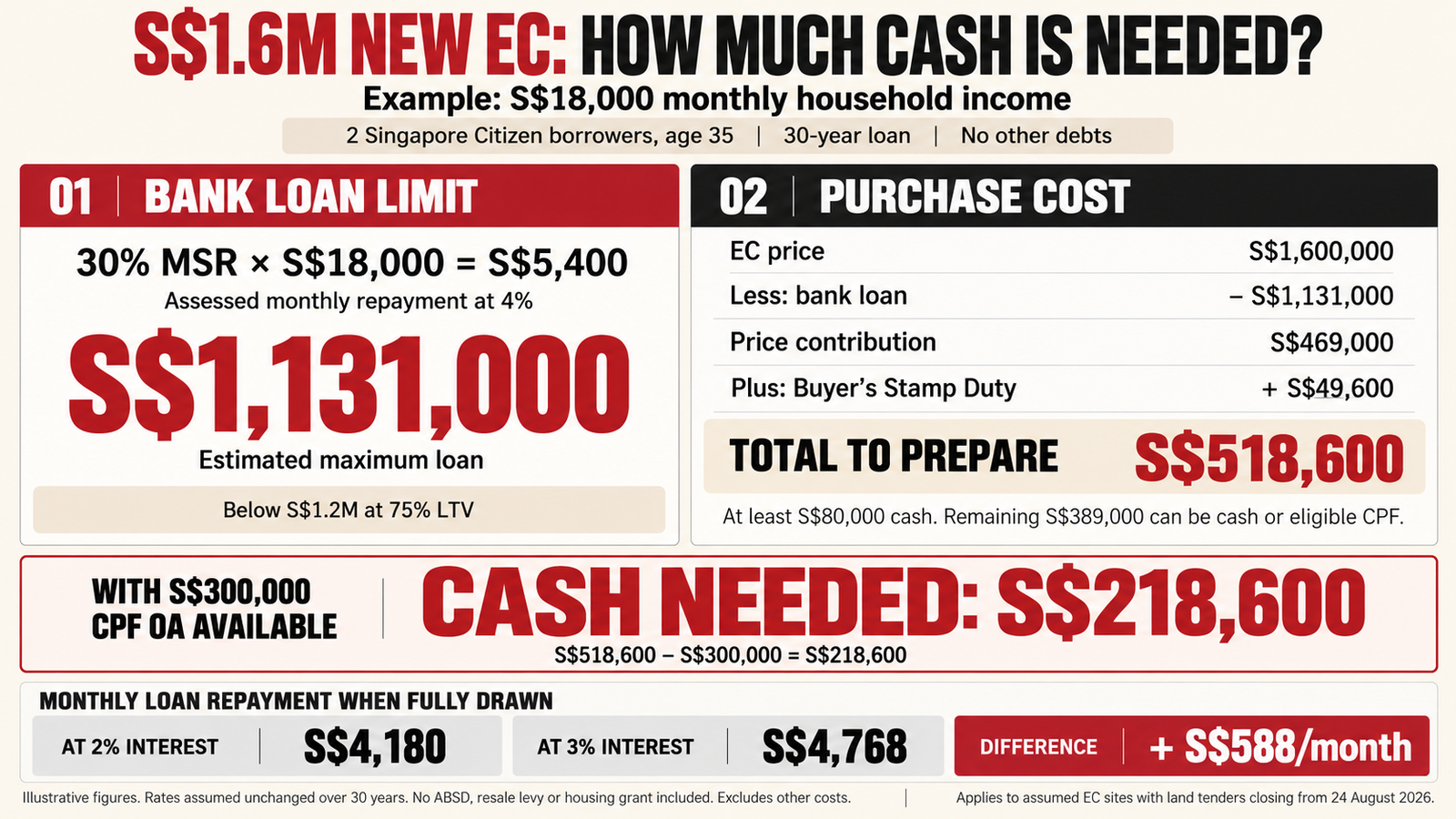
Let’s use two examples for projects under the rules applying to land tenders closing from 24 August 2026. These prices are illustrations, not market averages or homes currently offered for sale.
In both examples, assume two Singapore Citizen borrowers aged 35, a 30-year loan and no other debts. The bank values the home at the purchase price and uses 4% to assess the loan. The lease is long enough for the assumed CPF use. For the upgrader, assume the old HDB loan has been paid off. Estimated loans are rounded down to the nearest S$1,000.
The first family earns S$18,000 a month. The 30% MSR allows an assessed monthly repayment of S$5,400, supporting a loan of about S$1.131 million. That’s below the S$1.2 million they would get from a full 75% loan.
For a S$1.6 million EC, this leaves S$469,000 for the family to pay towards the price. At least S$80,000 must be cash under the assumed loan category. The other S$389,000 can come from cash or eligible CPF Ordinary Account savings. Buyer’s Stamp Duty, or BSD, adds S$49,600. The family’s contribution towards the price and BSD comes to S$518,600. [13][14]
If they have S$300,000 of CPF savings available for these costs, they still need S$218,600 in cash. There’s no resale levy or Additional Buyer’s Stamp Duty, or ABSD, in this Singapore Citizen first-property example. Their income is above the EC housing-grant limit, so no grant is included. [16][17]
Once the full loan is drawn, the monthly repayment is about S$4,180 at 2%, or S$4,768 at 3%. That’s around S$588 more each month. Both examples assume the rate stays unchanged over 30 years.
Note: These aren’t actual bank interest rates. For illustration only
What would a S$1.8 million EC cost an HDB upgrader?
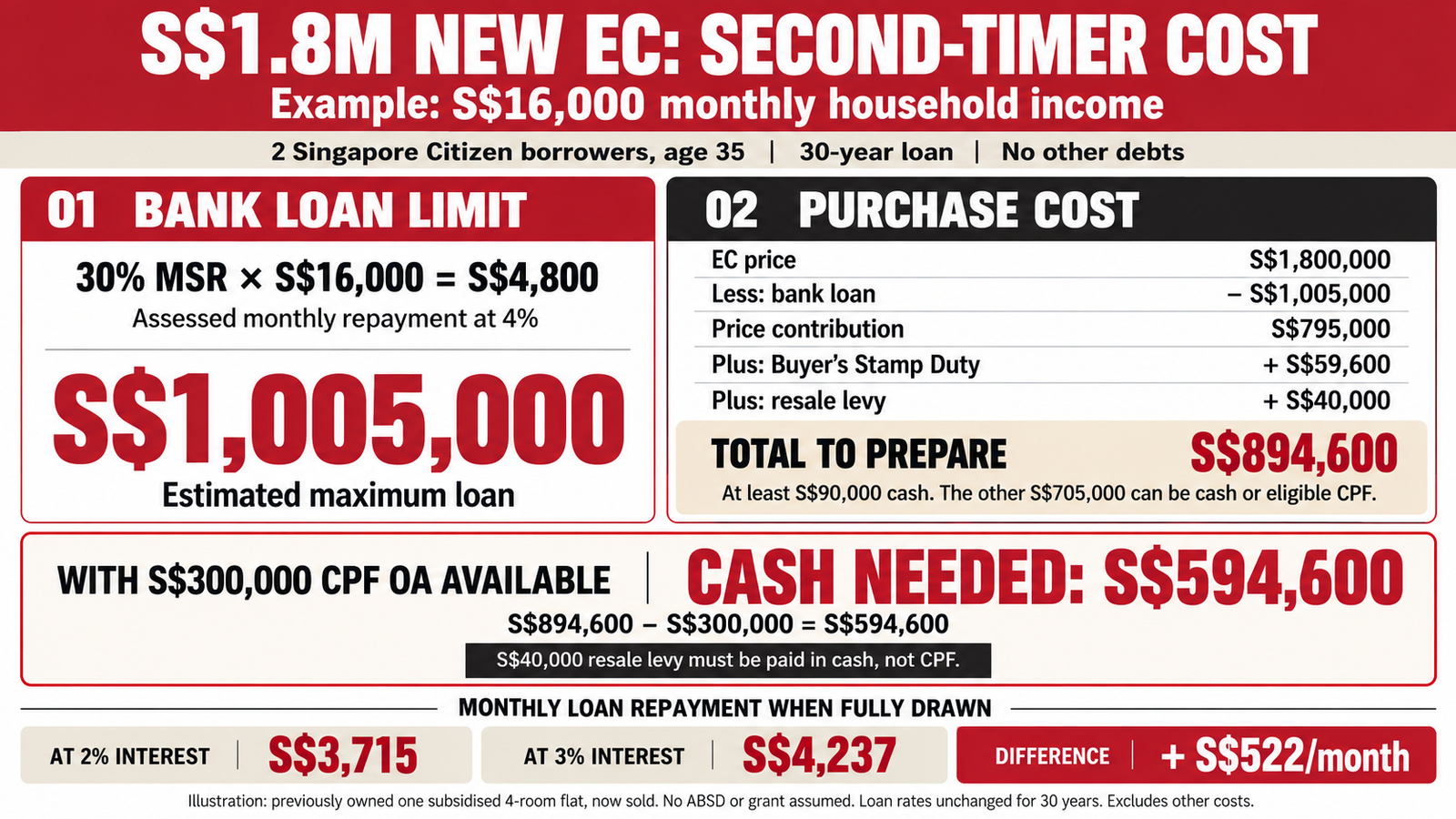
Now take an eligible second-timer family earning S$16,000 a month. Using the same ages, loan term and assessment rate, the MSR allows S$4,800 a month. That supports a loan of about S$1.005 million.
For a S$1.8 million EC, the family needs to pay S$795,000 towards the price. At least S$90,000 must be cash. The other S$705,000 can come from cash or eligible CPF savings. BSD adds S$59,600. [13][14]
Assume they previously owned one subsidised four-room flat and owe a S$40,000 resale levy under the fixed-levy rules. Adding the levy brings their price contribution and these charges to S$894,600. [7]
With S$300,000 of usable CPF savings, they need S$594,600 in cash, including the levy. The levy must come from cash or sale proceeds, not CPF. No grant is included. There’s no ABSD under the stated circumstances, where these Singapore Citizen buyers have already sold their flat. [7][16][17]
Once fully drawn, the loan costs about S$3,715 a month at 2%, or S$4,237 at 3%. The increase is about S$522, calculated before rounding. Their monthly repayment is lower than the first family’s because their loan is smaller. But they need much more money upfront.
The families have different incomes, purchase prices and subsidy histories. These examples show how the numbers can work out, rather than a standard extra cost that every upgrader pays.
Both budgets still need room for legal and loan fees, renovation, moving, temporary housing and emergency savings. Maintenance, property tax, insurance and utilities add to ongoing costs. The totals above also aren’t all due on booking day.
Will I need to pay ABSD or a resale levy?
New ECs have a specific ABSD relief. IRAS says ABSD is fully waived for a qualifying purchase with at least one Singapore Citizen buyer, automatically when HDB approves the purchase. This matters if you’re an eligible HDB upgrader buying before selling your flat. You don’t follow the usual private-condo route of paying ABSD first and applying for a refund later. [15]
A resale EC doesn’t get that same automatic treatment. A Singapore Citizen buying a resale EC as a second residential property generally faces 20% ABSD before any applicable relief. For a S$1.8 million purchase, that’s S$360,000. The order in which you buy and sell can make a big difference to the budget. [15][16]
A resale levy is a separate charge linked to an earlier housing subsidy. The S$40,000 in the upgrader example won’t apply to everyone. Your previous home and circumstances determine the amount. [7]
Housing grants are separate again. Eligible first-timer families can receive up to S$30,000, but no EC grant is available above S$12,000 household income under the current schedule. Qualifying under a higher income ceiling doesn’t automatically mean you receive a grant. [17]
When do I pay, and should I sell my flat first?
You start with a 5% cash booking fee. Your purchase contract sets the deadline for the next 15%, payable in cash or eligible CPF. Later payments follow construction progress. Paying the first 20% doesn’t mean the bank will cover the other 80%. Any amount above your approved loan still needs funding. [20]
The bank releases the loan in stages too. Early repayments may be lower than the full-loan figures above, then rise as more money is drawn.
Some earlier-rule projects may offer deferred payment. Check the actual price and terms, because paying later doesn’t make the home cheaper. For land tenders closing from 8 May 2026, deferred payment is removed and buyers pay progressively as construction advances. [1]
Buying before selling may let you stay in your HDB flat while the EC is being built. The catch is timing. Your first EC payments can arrive well before the money from your flat sale, and you may have two housing loans to pay for a while.
With the required promise to sell your HDB flat and supporting documents, you may qualify for the higher loan limit despite still having an HDB loan. The bank may also leave that existing instalment out of its TDSR calculation. Confirm the conditions with your bank. You still need to make the actual old-loan payments. [10][21][22]
Selling first gives you a clearer view of your cash and CPF, but you’ll need somewhere to stay. At an assumed rent of S$3,500 a month, two years costs S$84,000 before deposits and moving. A longer wait costs more. A short-term bridging loan also won’t cover a funding gap lasting several years.
HDB’s post-purchase guidance says you must sell your existing flat within six months of collecting the EC keys. That means completing the sale, not just finding a buyer. Check the exact deadline in your HDB undertaking and work backwards from there. [4]
How long do I need to stay, and can I rent out the home?
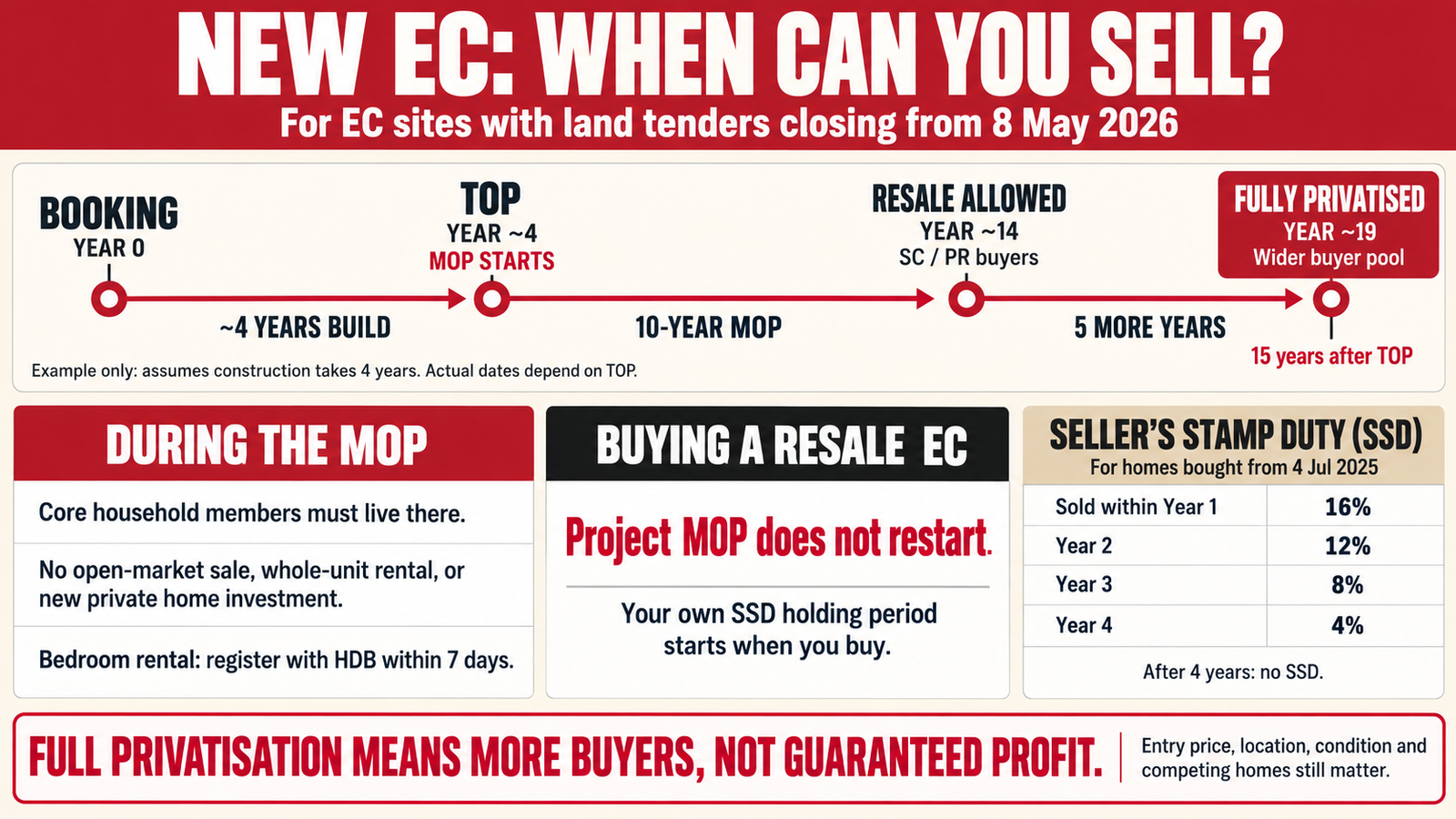
The MOP starts from TOP, not the day you book. If construction takes four years and your EC has a 10-year MOP, you’re looking at roughly 14 years from booking before a normal open-market sale. Ask yourself whether the home can suit your family for that length of time.
During the MOP, the household members used to qualify for the purchase must live there. You can’t normally sell on the open market, rent out the whole home or invest in another private residential property. Renting out bedrooms is different, but you must register the rental with HDB within seven days. [4]
For a resale EC, the project’s MOP doesn’t restart when you buy. However, Seller’s Stamp Duty can still apply to your own purchase. For homes bought from 4 July 2025, selling within four years can attract rates of 16%, 12%, 8% or 4%, depending on how long you’ve held the property. Keep that separate from the project’s MOP and privatisation dates. [23]
Full privatisation allows more types of buyers to purchase the home. A wider buyer pool can be useful, but doesn’t guarantee a profit. The price you paid, location, condition and competing homes still matter, along with your ownership costs.
So, would I still consider an EC?
Yes, if you qualify, can comfortably fund the purchase and expect to stay for the full MOP. For some families, the higher income ceiling gives them a new option. The larger first-timer reservation also gives eligible first-timer families more priority at affected launches.
If you’re upgrading from an HDB flat, I’d start with the money and moving dates. How much cash will the sale leave you? How much CPF can you use? Can you cover the EC payments before those funds arrive? An earlier-rule project may offer more flexibility, but the price still needs to work for you.
For first-time buyers and young families, look beyond getting the keys. Will the bedrooms, school journeys and commute still suit you as your family changes? A longer MOP is easier to plan around when you’re choosing a home you’ll be happy to stay in.
If your income is above the relevant ceiling, you can’t meet the private-property waiting period, or you need a completed home, compare resale ECs and private condos. Their financing and tax rules differ. Waiting is also reasonable if your savings or moving plans aren’t ready.
Before booking a showflat visit, check the project’s land-tender date and your household eligibility. Then get a bank assessment, add up your cash and usable CPF, and match each payment to your selling and moving dates. You’ll have a much clearer shortlist once you know what fits.
Talk through your options with John Lai
Thinking of getting a EC?
WhatsApp me, John Lai, at 84440899. Let's go through you the options and I’ll help you work out the full costs and plan the move, so you can decide with a clearer idea of what suits you.
Frequently asked questions
1. My household earns S$18,000. Can we buy any new EC?
No. The S$18,000 ceiling applies to new units on sites whose land tenders close on or after 24 August 2026. Earlier projects and their unsold units don’t automatically get the higher ceiling. Check the project before ruling yourself in or out. [2]
2. Can HDB upgraders still buy new ECs?
Yes, if you meet the eligibility rules. Second-timers can still apply. Under the newer rules, 90% of units are reserved for first-timer families for two years, so second-timers have fewer choices during that period. [1]
3. Do I need an HDB Flat Eligibility letter for a new EC?
You apply through the EC developer, which handles the eligibility and grant process. You also need a separate bank assessment. An HDB Flat Eligibility, or HFE, outcome for an HDB flat doesn’t approve your EC purchase or bank loan. [20][24]
4. Can I use CPF for all the upfront costs?
No. The cash booking fee and any resale levy need separate funding. You can use CPF Ordinary Account savings for other eligible costs, within the available balance and withdrawal limits. Allow time for CPF processing too. [7][19][20]
5. Can I sell my new EC after five years?
Check the project’s land-tender closing date. Earlier-rule projects have a five-year MOP from TOP. Sites whose tenders close on or after 8 May 2026 have a 10-year MOP. The waiting period starts from TOP, not when you book. [4]
Thinking about an EC but unsure where you stand? WhatsApp me at 84440899 with your household income, current home and budget. We can go through your options and work out what the move would involve.
Disclaimer:
This report is for informational purposes only and is based on available data and assumptions at the time of preparation. Actual outcomes may differ due to market conditions, execution, and other uncertainties. No guarantee of accuracy, completeness, or future performance is made. Readers should independently verify key information before making decisions. John Lai shall not be held responsible for any subsequent changes or inaccuracies.
Sources:
Rules and sources checked on 10 October 2026.
[1] CNA, EC ownership, payment and first-timer priority changes, 8 May 2026.
[2] HDB, Increase in Income Ceilings and Greater Support for Families with Children, 22 August 2026.
[3] HDB, Eligibility for Buying an Executive Condominium.
[4] HDB, Conditions After Buying an Executive Condominium.
[5] HDB, Finding an Executive Condominium and resale eligibility.
[6] HDB, EC land sites sold, page 1, retrieved 29 October 2026.
[7] HDB, Conditions After Buying a Resale Flat, occupation periods and resale levy.
[8] HDB, Income Guidelines and Documents.
[9] CNA, HDB income-assessment changes and application to ECs, 8 May 2023.
[10] MAS, Calculating TDSR for Property Loans.
[11] HDB, Removal of the 15-month Wait-out Period, 28 July 2026.
[12] MAS, Mortgage Servicing Ratio and Total Debt Servicing Ratio Rules.
[13] MAS, Loan Tenure and Loan-to-Value Limits.
[14] IRAS, Buyer's Stamp Duty.
[15] IRAS, Acquisition of HDB Flats and New EC Units: ABSD Remission.
[16] IRAS, Additional Buyer's Stamp Duty.
[17] HDB, CPF Housing Grant for an Executive Condominium.
[18] CPF Board, CPF Refund When Selling or Transferring Property.
[19] CPF Board, How Much CPF Savings You Can Use for Your Home Purchase.
[20] HDB, Process for Buying an Executive Condominium.
[21] Joint government release, housing-loan undertaking concession, 11 January 2013, Annex II.
[22] DBS, Terms and Conditions for All Loan Applications, existing-property declaration.
[23] IRAS, Seller's Stamp Duty for Residential Property.
[24] HDB, Housing Loan from Financial Institutions.
[25] MAS, Housing-loan affordability safeguards, 7 October 2026.